How can a goalkeeper improve their distribution accuracy and distance? The fastest way to elevate your distribution game is to eliminate three critical mechanical errors: 'The Windmill Arm,' 'The Flat Foot,' and 'The Locked Hip.'
Modern goalkeeping requires the 'Number One' to be the first point of attack, meaning your distribution metrics are often more important to college scouts than your shot-stopping stats.
Mistake 1: The "side Arm" (Throwing side-Rotation)
When throwing, many keepers dont feel like they have control over the ball and are forced to throw ball using a side arm techniques. Most often it over-rotates and spins. This type of movement is very difficult to control for the field player and may mean losing possession of the ball.
- The Lab Fix: Focus on a linear "windmill" motion. Keep your elbow high and release the ball with a straight over-the-top snap, using your core—not your shoulder—for power.
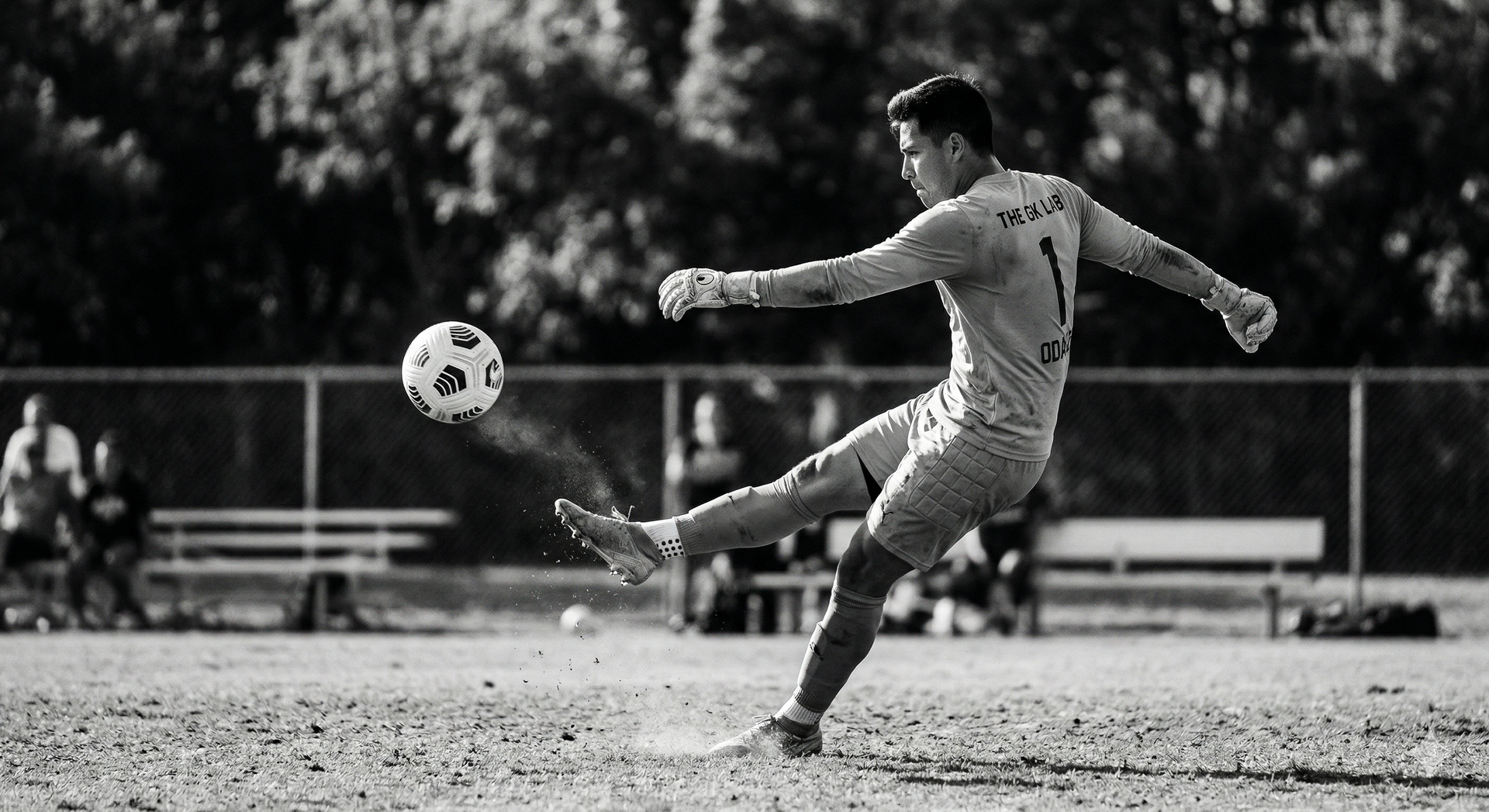
Mistake 2: The "Flat Foot" (Kicking Mechanics)
Whether drop-kicking or side-volleying, a "flat" plant foot kills power. If your non-kicking foot is planted firmly on the ground, you cannot transfer your body weight through the ball.
- The Lab Fix: Get "active" on your plant foot. As your kicking leg comes through, your plant foot should initiate a skipping motion, allowing your body to move
forward and up, driving your momentum into the kick. This is the difference between a 30-yard punt and a 60-yard "ping."
Mistake 3: The "Locked Hip" (Lateral Volleys)
On side-volleys (the preferred modern distribution), keepers often "lock" their hips. They kick with just their quad, resulting in a low, weak ball that is easily intercepted.
- The Lab Fix: Turn your hips
over the ball. Think about pointing your belly button toward your target at the moment of contact. This "hip-over" mechanic creates a flat, high-velocity trajectory that can cut through a defensive line.
The Science Behind the Save (Distribution Edition)
In our
Catalyst Lab sessions in Waco, we use video review to identify these mechanical flaws. Correcting these three mistakes doesn't require more strength; it requires
The Science of Technique.